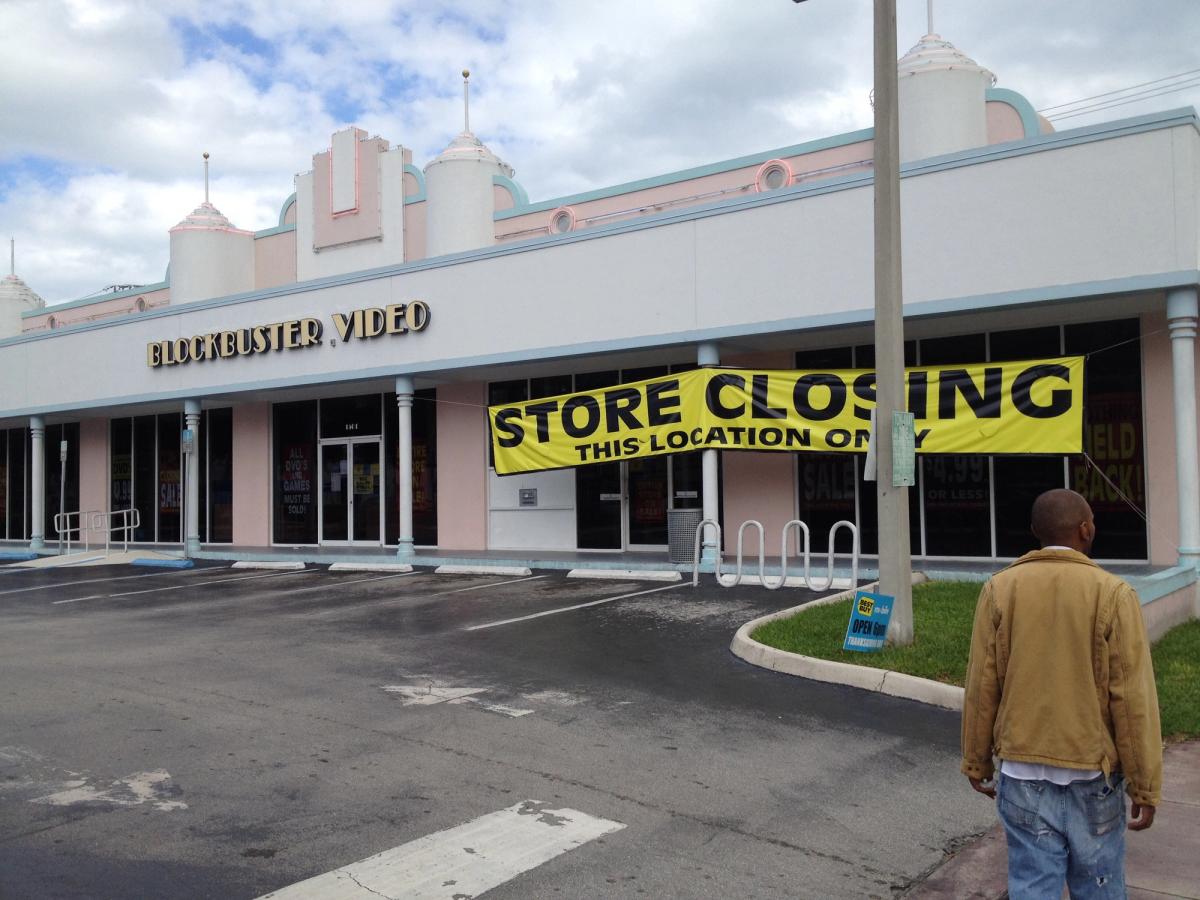
In 2005, the two largest video rental chains in America were locked in a bitter feature war.
Blockbuster, with roughly 9,000 stores worldwide, was experimenting with "No More Late Fees" campaigns, redesigning its store layouts, and quietly hemorrhaging the ~$800 million per year in late-fee revenue (NBC News) that had made the business work for two decades. Hollywood Video — the second-largest chain, with about 2,000 stores under its banner and another 500 under its sister brand Movie Gallery — was fighting back with longer rental windows, "5 Day Rental" promotions, and price wars on new releases.
Each one had decided that the path to winning was to out-Blockbuster the other Blockbuster.
While they were fighting, a 6-year-old DVD-by-mail startup with no stores, no late fees, and no shelf space was quietly building the model that would end both of them. In 2000, that startup had tried to sell itself to Blockbuster for $50 million. Blockbuster's executives reportedly laughed Netflix's co-founders out of the room.
Five years after the 2005 store-redesign battles, both Blockbuster and Movie Gallery — Hollywood Video's parent — filed for bankruptcy (SEC 8-K, Blockbuster Inc.; Movie Gallery Chapter 7 announcement). By August 2010, all 2,500 Movie Gallery / Hollywood Video / GameCrazy stores were closed. By the end of 2013, all but a handful of Blockbuster stores were too.
Netflix is worth around $200 billion as of this writing.
This is the parable that maps almost exactly onto what Compass and Zillow are doing to each other in 2026.
The 2005 Playbook, Translated
Blockbuster and Hollywood Video weren't fighting over whether physical-retail DVD rental was a good business. They were fighting over which of them got to be the biggest, last physical-retail DVD rental company.
That was the wrong question. The whole category was being disrupted from outside by a model that had structurally different economics, structurally different unit costs, and structurally different customer access. While they argued about late fees and store windows, Netflix built infinite-shelf inventory, a mailing-envelope distribution system that cost almost nothing per unit, and — by 2007 — a streaming product that made even DVD distribution obsolete.
Compass and Zillow are not fighting over whether the 5–6% commission + portal-controlled-listing-data model is a good business. They are fighting over which of them gets to control more of that model.
| Home sale price | Listing side at Loqol's 2.5% | Total at a traditional 5% | Total at a traditional 6% |
|---|---|---|---|
| $50,000,000 | $1,250,000 | $2,500,000 | $3,000,000 |
| $800,000,000 | $20,000,000 | $40,000,000 | $48,000,000 |
What the Customer Was Actually Paying For
In 2005, when you walked into a Blockbuster to rent Million Dollar Baby, you were paying for four things bundled into one $4.99 rental fee:
- The actual content (the movie itself)
- A physical-retail distribution network (the store, the shelves, the clerks, the lighting, the carpet)
- A late-fee penalty system designed to extract more revenue from your forgetful habits
- The privilege of having Blockbuster's marketing team decide which movies got prime shelf placement at your local store
Netflix unbundled all of those.
Content was the same — Netflix had access to the same DVD catalog Blockbuster did. But the physical-retail distribution network became a postage stamp. The late-fee penalty system became zero. And the "what's on the shelf" curation problem became "what's in your queue" — controlled by you, not by the marketing team in Dallas.
The customer didn't lose anything they actually valued. They just stopped paying for three things they never wanted to pay for in the first place.
In 2026, when you list a home with a 5–6% traditional brokerage on a $1.5M Bay Area home, you are paying $75,000 to $90,000 bundled across:
- The actual work of selling the home — MLS listing, disclosures, showings, paperwork, escrow coordination
- A brokerage's physical-retail distribution network (the office, the agent roster, the brand-marketing budget, the print mailers, the open-house signs)
- A walled-garden inventory game designed to keep listing data inside one brokerage's network as long as possible
- The privilege of having Compass or Zillow or some MLS partnership decide which buyers actually get to see your listing during the most active window of its life
The actual work — #1 on that list — has not gotten more expensive in 30 years. The lockbox didn't get harder to install. The MLS form didn't get longer. The disclosures, in California, were standardized by the DRE and the C.A.R. forms library.
Everything that's gotten more expensive is items #2, #3, and #4 — the parts the seller never actually wanted to pay for in the first place.
The Walled-Garden Tell
Here is the cleanest tell that a business is about to be Blockbuster: it builds walls around things its customers want to be open.
Blockbuster built walls around inventory (exclusive new-release windows), around membership (in-store-only signups), and around access (no online catalog browsing until very late, no streaming until far too late). The walls were the moat. The moat became the cage.
Compass is building walls around inventory (Private Exclusives), around membership (the Private Listing Network with subsidized agent enrollment), and around access (four MLS partnerships that route listing data off the public portals). The walls are the moat. The moat is becoming the cage.
Zillow is building walls around display (Listing Access Standards — show on Zillow's terms or don't show at all), around data ingestion (the 24-hour rule), and around portal-network effects (200 million monthly visitors). The walls are the moat. The moat is becoming the cage.
The trouble with walled gardens in markets where the underlying product is fungible — a movie is a movie; a house listing is a house listing — is that the wall is the only differentiator. As soon as a structurally better model offers the same product without the wall, the wall isn't a moat anymore. It's a sign on the front door that says we charge for friction.
The model that wins is the one that removes the wall.
What "Mailing the DVD Back" Looks Like in Real Estate
In 2005, the Netflix customer experience was: red envelope arrives in the mailbox; you watch the movie; you stick it in the same red envelope and drop it back in the mailbox; the next movie arrives a few days later. Zero stores. Zero late fees. Zero curation by a marketing team in Dallas. Zero arguments with the clerk about whether the case was open when you grabbed it.
The 2026 equivalent for a home seller is: a full-service, software-driven listing workflow with a dedicated licensed agent, complete portal exposure, and no walled-garden leverage games.
That's what LOQOL is. We are a full-service California brokerage (Sunday Real Estate Brokerage Inc. dba Loqol, CA DRE #02261474) with dedicated licensed agents. When you onboard through Loqol, we charge a 2.5% seller-side commission. This includes a dedicated licensed agent reachable directly at any point in the transaction, a seller dashboard with full visibility into the deal, all documents and disclosures in one place with complete deal and document history, signage installation, and marketing run by Loqol's in-house marketing team. Every Loqol agent is a licensed California agent we onboarded with prior transaction experience, and our roster has closed 100+ listings between them. Our agents work on software we built ourselves, so every disclosure, deadline, and document in your sale is tracked rather than remembered — and you can see all of it, and reach your agent, in one click. Charlie is Loqol's in-house AI. Our agents use it to run the transaction, and in your seller dashboard you can ask it what's happening with your sale at any point and get an answer grounded in your actual deal — with your agent one click away.
We don't have a Private Listing Network. We don't partner with MLSs to channel inventory off public portals. We don't withhold listings from Zillow when we disagree with their policy choices. Your listing goes on every MLS that covers your area, every major portal — Zillow, Redfin, Realtor.com, the Compass site, every brokerage that syndicates public IDX data. Every buyer, everywhere, gets to see your home.
That isn't a marketing claim. It's the absence of a marketing claim. Walled gardens are something brokerages have to actively build. We just don't build them.
The Seller Isn't Picking a Side. The Seller Is the Side.
Watch how almost every piece of media coverage of the Compass-Zillow listing war frames the seller. The seller is incidental. The seller appears in the third paragraph as a quoted reaction. The seller is the noun that gets used to justify both sides' positions — we're doing this for the seller; no, we're doing this for the seller.
The seller is the way that Blockbuster and Hollywood Video used to talk about "the customer" in their 2005 investor decks. Our customers love the in-store experience. Our customers value the human curation. Our customers prefer the membership benefits.
The customer was mailing the DVD back the entire time.
The seller is doing the equivalent now. Every month, more sellers in California, in Florida, in Texas, in the Mid-Atlantic, are looking at a $30,000 to $300,000 commission bill on a home they built equity in by living in for 10 to 30 years, and they are running the math. They are asking themselves whether a brokerage that fights this hard to control their listing data is actually working for them, or just using them.
The answer to that question is the slow process by which Compass and Zillow become Blockbuster and Hollywood Video. Not in a single dramatic news cycle. Not in a single court ruling. Just one seller at a time, each month, deciding that the wall isn't worth $50,000 of their equity.
The math is the math. The model is the model. The DVD is already in the mailbox.
Frequently Asked Questions
Is Compass the new Blockbuster?
The structural parallel is close. Both are the largest incumbent in their category (Blockbuster: video rental; Compass: residential real estate brokerage). Both have built private-network strategies that route inventory away from the open-access channels their customers actually use (Blockbuster: in-store membership and exclusive windows; Compass: Private Exclusives and four MLS partnerships routing listings off public portals). Both have fought their primary peer in increasingly bitter feature wars rather than reconsidering the underlying model. The 2010 Blockbuster bankruptcy outcome isn't predetermined for Compass — but the playbook that produced it is the playbook Compass is running.
Is Zillow the new Hollywood Video?
Zillow's position is closer to Hollywood Video's than Blockbuster's, structurally — second-largest in the category, defending the same percentage-and-walled-garden model from a different angle. Zillow's Listing Access Standards and 24-hour rule are the portal equivalent of Hollywood Video's "longer rental window" promotions — defending the same business by changing one variable while leaving the rest in place. Both are structurally exposed to the same disruptor.
What is the structural disruptor?
A full-service, software-driven brokerage with dedicated licensed agents. The model focuses on net proceeds and execution, removing the private-listing-network moat and replacing manual workflows with software-driven listing operations. LOQOL is one example — a licensed California brokerage (CA DRE #02261474) charging a 2.5% seller-side commission. Other limited-service MLS companies exist; the difference between LOQOL and pure fixed-fee MLS entry services is that LOQOL provides a dedicated licensed agent of record with full fiduciary duty, signage, in-house marketing, and a comprehensive seller dashboard.
Did Blockbuster really turn down a chance to buy Netflix?
Yes. In 2000, Netflix co-founder Marc Randolph and CEO Reed Hastings flew to Dallas and offered to sell Netflix to Blockbuster for $50 million. Blockbuster CEO John Antioco's team reportedly "laughed us out of the room," per Randolph's own account. Netflix is worth roughly $200 billion as of this writing. The $50M-to-$200B trajectory is the cost of the wrong gravity assumption.
When did Blockbuster and Hollywood Video go bankrupt?
Movie Gallery (Hollywood Video's parent company) filed Chapter 11 in February 2010 and Chapter 7 in April 2010; all 2,500 Movie Gallery / Hollywood Video / GameCrazy stores closed by August 8, 2010. Blockbuster filed Chapter 11 on September 23, 2010 (Blockbuster Inc. 8-K SEC filing). Both companies were bankrupt within 6 months of each other.
What does this mean for me as a seller?
The strategic question to ask any listing brokerage you're considering: does your business model depend on controlling listing data in a way that competes with your client's interest in maximum buyer visibility? If yes — walled-garden private networks, MLS partnerships designed to route inventory off the open portals, threats to cut listing feeds during corporate disputes — that's a structural risk to your sale. If no — every MLS, every major portal, every buyer, every time — that's a brokerage that has aligned its incentives with yours.
Is LOQOL only in California?
LOQOL is a California-licensed brokerage (CA DRE #02261474) operating statewide. Read the What Is LOQOL? answer page for the full breakdown of how our dedicated licensed agents use our proprietary software and Charlie AI to run your transaction.
Related Reading
- The Compass-Zillow Listing War, Explained: Why It Matters If You're Selling Your Home
- What Is LOQOL? The California Real Estate Brokerage Built Around Proprietary Software
- Commission Structures: California Sellers Guide
- A Marin Neighbor Said His Commission Bill Went From $12,000 to $60,000. Nextdoor Deleted the Post — Twice.
- LOQOL vs Compass vs Keller Williams vs Coldwell Banker vs eXp Realty (Bay Area 2026)
Alex Lyman is the founder of LOQOL, a full-service residential real estate brokerage licensed in California (Sunday Real Estate Brokerage Inc. dba Loqol, CA DRE #02261474). LOQOL lists every home on every MLS and every major portal — no private networks, no exclusive feeds, no leverage games.
Reporting in this post draws on coverage from [NBC News](https://www.nbcnews.com/id/wbna39332696), [Fortune](https://fortune.com/2023/04/14/netflix-cofounder-marc-randolph-recalls-blockbuster-rejecting-chance-to-buy-it/), the [Hollywood Reporter](https://www.hollywoodreporter.com/business/business-news/movie-gallery-shutter-760-stores-20228/), and Blockbuster's [SEC filings](https://www.sec.gov/Archives/edgar/data/0001085734/000119312510215765/d8k.htm), plus the timeline established in our prior coverage of the [Compass-Zillow-MRED dispute](https://loqol.ai/blog/compass-zillow-listing-war-explained).
Sell with a dedicated Loqol agent
Loqol is a full-service California brokerage. Every Loqol agent is a licensed California agent we onboarded with prior transaction experience, and our roster has closed 100+ listings between them.
Talk to a Loqol agent about your sale — a licensed agent, not a form queue, follows up.
Want more clarity like this?
Clear, actionable guidance on selling and buying — straight to your inbox.